cognitivesculpture_wrmlike
transfiguration operation: toward a material emancipation in service of a cognitive sculpture
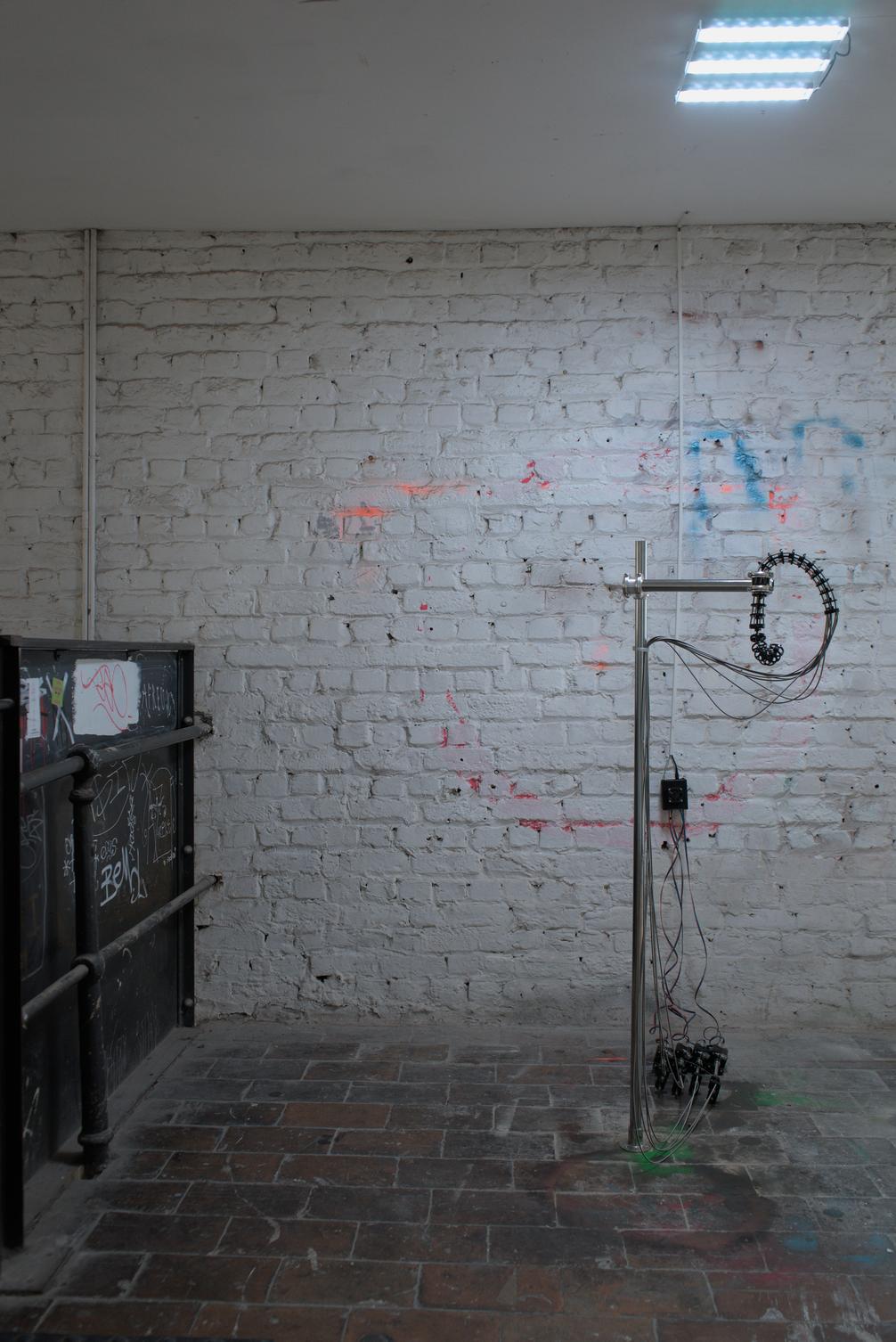
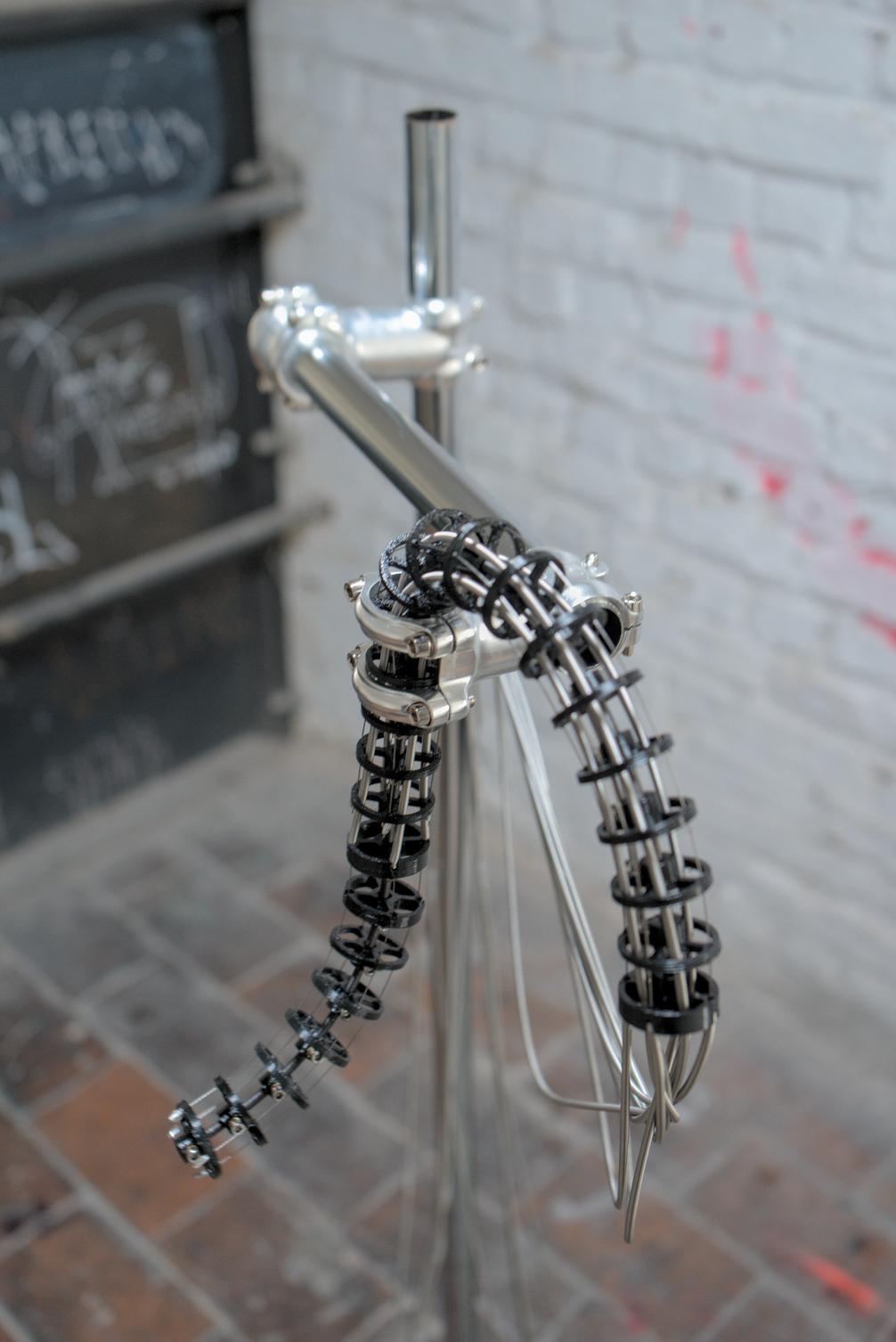
worm_like form is a translocation of formal stakes drawn from the field of "continuum-robotics" research existing since the 1960s (Scheinman, 1965)(Anderson, 1967). It is also used in the production of mechanical special effects as an internal effector of movement. The form is often covered with biomorphic skin (soft sculpture) and interacting organs (ocelli, mouth, nasal duct), providing the conditions necessary for its identification as a probable living alterity.
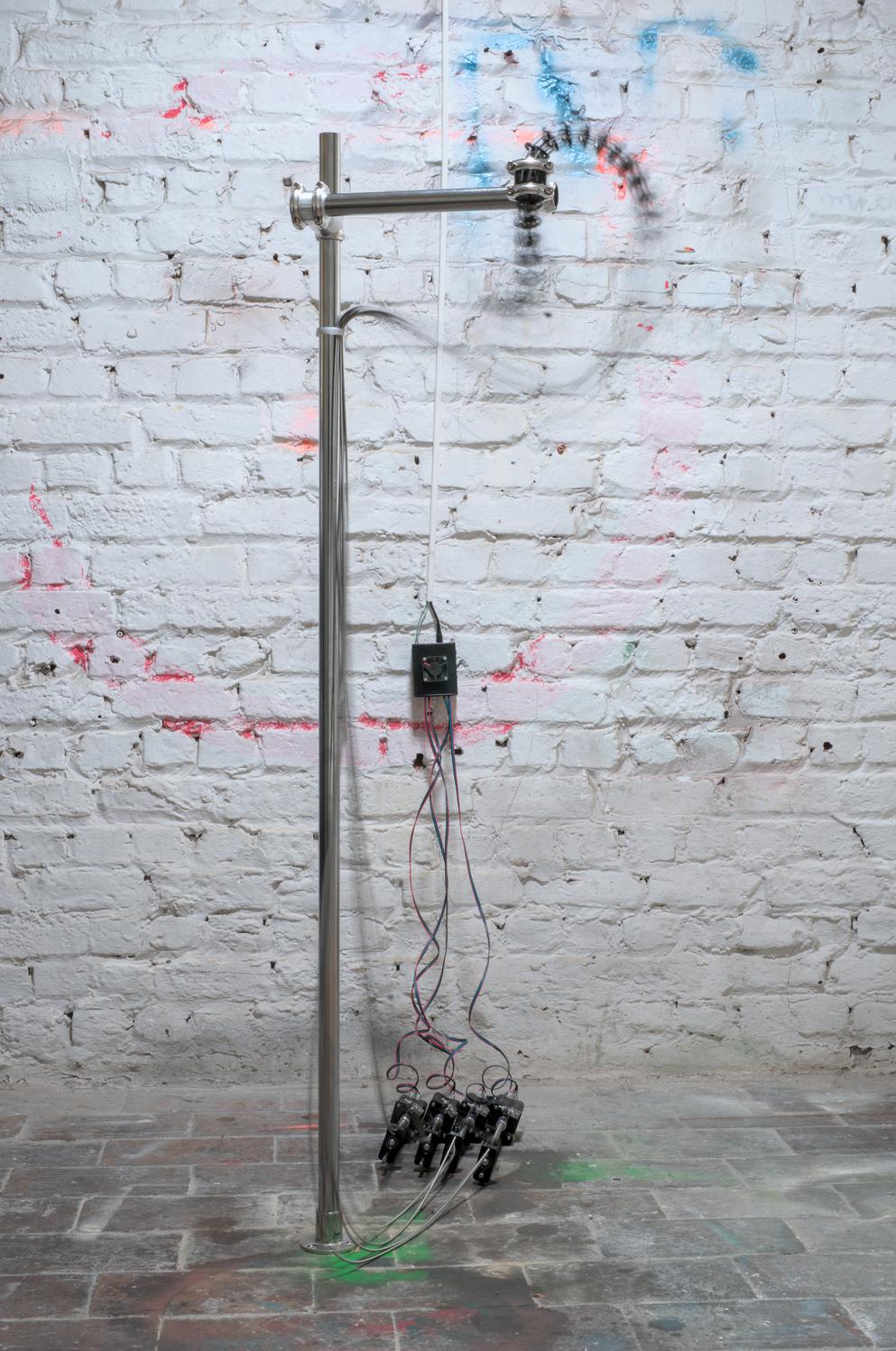
The intervention is an operation of denuding: the aim is to reconsider this form in order to propose a machinic alterity reduced to its material minimum. Its existence proper is reduced to the evocation of its mechanical functioning (activation of cable-tendons). Breaking away from a possible feeling of uncanniness, by dissociating itself from the mimetism of materials close to organic physiology (carnation texture, flesh tone, …).
medium movement: hybridization of the taxonomies of alterity
The austere mechanical presence of the device allows for a physical interaction with the — minimal — internal sculpture of the machine. Developing — if any remains — a basal biomorphism: convoking the form of the worm, hardly sentient, absolutely distant from any possible pareidolia.
This formal minimalism is grasped as a possibility for investigating relational stakes with the machine. The interactivity and movement (integration of feedback) that follows surpasses the physical existence of the piece in favor of its kinetic presence — making its behavior (automation) the core of the device.
The form, aware of the occupation of the milieu (bodily positions), deploys different tracking patterns: tending toward the most occupied zone as if calling for attention, calling for an awareness of its captivity. Also relying on the level of spatial activity, it will respond with movement that becomes more erratic and unmasterable (random) the higher the level of environmental agitation: which may suggest a panicked struggle in response to the spectatorial pressure tied to the exhibition regime (its existence as artwork) to which it is subjected.
A set of very minimal behaviors, yet developing a sense of alterity through its own somatic cognition of space and its ability to produce unmasterable movements.
Questioning at the same time the limits of human capacity for emotional deployment (empathy, fear, ...): the device acts as a medium for the cognitions traversing it. Constructing as many neural projections as the individualities confronting it — producing as many bodily interventions as sensibilities to alterity. Calling into question the great modern taxonomies of categorization. Accomplishing the intention of maximal — psychic — occupation through a minimal material intervention.
dissidence and soft body (soft-robotics)
Almost wetware in the image of a soft/supple organicity, the soft-robotic device always intervenes in space contingently upon the whole set of milieu parameters. The machine is soft, not meeting the deterministic taylorist requirement (iterability and precision of movement), thereby excluding it from industrial production schemes. It thus finds itself dissident to the rationalist apparatus from which it emerges. Distancing itself from the nature/culture scission (schism) project evoked and produced by the use of the machine: it is, in sum, incapable of serving any modern project.
A non-predatory machine, it can establish itself in contact with bodies, in an encounter proposing another relation to robotic alterity: possibly sensual, possibly provocative, but never destructive. wormlike establishes a new paradigm of human/machine alterity, allowing for a redefinition of the speculative ideals of human–mechanical interdependence.
contensionnary architecture and posture of complicity with control
The dissident soft body, with its own cognition, is exposed and constrained by a chromed entity firmly implanted in the foundations of the host site. By physically traversing the space, we become complicit in the architecture of control over the detained alterity. Our inevitable passivity in the face of unsolvable technical complexity would induce a posture of guilt. By disabling our possibilities of intervention, we ourselves become subject to our emotional projection onto the machine: the reaction developed through interaction with the detained form suddenly becoming symptomatic of our relation to a speculative concentrationary device.